Ethnic Studies
Apply NowProgram Description
Ethnic Studies provides a learning space for students to examine the role of power and how it shapes race, ethnicity, class, gender, sexual identity, ability, age, citizenship, spiritual belief and language. It provides critical lens to interrogate and contextualize contemporary social issues and ways communities of color express resistance. By taking one of our courses, students become more knowledgeable of the social and political issues in our country and empowered to become culturally competent and civically engaged change agents.
The Program
Ethnic Studies is a comparative and interdisciplinary field of critical race studies that centers on the experiences and contributions of people of Indigenous, African, Latinx, and Asian descent. Our courses provide students opportunities to deepen their understandings of colonial-constructed ideologies and systems and examine how they shape the experiences of communities of color.
Using a range of materials produced by authors and creators of color, queer scholars and other minoritized voices, we deeply examine power and how it influences the processes whereby social identities and categories of difference are (re)produced, supported, resisted, inhabited, embraced, and transformed across time and geographic space. In this examination, we also center the rich history of knowledge-making and culture-making within spaces of color and explore the innovative ways in which communities of color express forms of resistance and strategize in their liberation movements.
By familiarizing students with a range of methodological tools for the study of social and cultural life, while prioritizing the voices and perspectives of marginalized individuals and minoritized communities, we open up an intellectual space within which the term "ethnic" in "ethnic studies" is both critically deconstructed and strategically affirmed.
Career Outlook
The study of Ethnic Studies provides a broad base of knowledge and skills that can be applied to a wide range of careers including:
- Arts
- Business and marketing
- Community development and organizing
- Government and politics
- International relations
- Journalism and media
- Law
- Psychology and counseling
- Public health and medicine
- Social work
- Teaching and education at all levels
Looking for a list of classes offered this semester?
Check out the current class schedule.All Courses
ETHN 101 Latin American and Indigenous Peoples History and Culture (3 units)
Study of the historical and cultural presence of Native Americans/Indians and Latino[a] Americans in the United States. We will study the general background of two of America's oldest ethnic groups and examine issues that show racial and ethnic stereotypes as well as how these images create an ethnic identity.
ETHN 103 Asian Americans and US Institutions (3 units)
An examination of the Asian American experience in relationship to US institutions such as: economics, government, law, family, and mass media. A particular focus on the racial construction of Asian American identity and community through a historical, social, cultural, and political lens that explains Asian migration to the United States, construction of racialized stereotypes, anti-Asian violence, and community responses of political activism, organizing, solidarity, and liberation movements with Black, Indigenous, and People of Color communities (BIPOC).
ETHN 107 Introduction to Native American Studies (3 units)
In-depth exploration of the more than 500 Native American, Kanaka Maoli (Native Hawaiian), and Alaska Native nations, including historical and legal groundwork, cultures, languages, and intellectual traditions. Particular emphasis will be placed on California's tribal nations. Final project will require community engagement with California Native peoples' key issues.
ETHN 108 Rethinking Race, Gender, and Nation (3 units)
This course explores the intersections of race, ethnicity, gender, sexuality, and power in U.S. history through a Black, Indigenous, People of Color (BIPOC) lens, with a focus on whiteness, colonization, slavery, immigration, decolonization, self-determination, and resistance movements.
ETHN 109 Borders and Crossings (3 units)
Examines how the U.S. processes of racial formation and gendering are related to multiple transnational circulations – circulations of commodities, bodies, labor, capital, knowledge, and culture. We interrogate the material and ideological work of borders – particularly nation-state borders, but also the borders and boundaries of racial and ethnic categories, gendered and sexualized identities, languages, forms of labor, and disciplinary categories of knowledge. Also explored are the many ways in which such borders are variously resisted, contested, transgressed, transcended, and transformed over time.
ETHN 120 Introduction to Black Studies (3 units)
An introductory overview of Black Studies, critically examining its academic origins, socio-political contexts, and intellectual traditions. Students will explore foundational theories such as double consciousness, Black feminist thought, and African worldviews, while analyzing concepts like race, racism, white supremacy, self-determination, and decolonization. The course emphasizes the struggles for liberation, equity, and community affirmation in Black communities, and explores how resistance, social justice, and political movements have shaped the Black experience.
ETHN 130 Introduction to Latina/o/x Studies (3 units)
An overview of Latina/o/x Studies as a discipline, examining and analyzing the academic origins, socio-political contexts and social movements such as the Chicano Movement, cultural contributions, lived experiences, and philosophies of Latinx communities. Concepts such as gender and sexuality, imperialism, racialization, settler colonialism, indigeneity, and capitalism will be analyzed in the context of Latinx experience.
ETHN 131 Chicana/o History, 1848-Present (3 units)
Survey of the history of Mexican people in the United States since the Mexican-American War through an Ethnic Studies lens. Emphasis will be placed on racial frameworks from their roots in the Spanish colonial period to the present, the development of a Chicana/o identity, and the contributions of Chicana/o people.
ETHN 140 Introduction to Asian and Pacific Islander American Studies (3 units)
An introduction to Asian and Pacific Islander American (APIA) Studies, examining contemporary approaches to understanding the histories, cultures, politics, and social experiences of APIA communities in the United States. Through critical analysis, students will explore key concepts such as race and racism, immigration, settler colonialism, the racialization of APIA identities, and ongoing movements toward anti-racism and anti-colonial resistance.
ETHN 141 Asian American History (3 units)
Historical survey of Asian American histories and struggles from early presence and the 49ers era through Japanese American incarceration to post 1965 immigrants, Southeast Asian refugees, and U.S.-born generations in globalization, centering race, class, gender, sexuality, language, immigration status, and interethnic/transnational relations, with attention to power, resistance, intergenerational change, and community self-determination.
ETHN 142 Filipina/o/x Community Issues (3 units)
An introduction to understanding contemporary social issues of Filipina/o/x Americans. Uses an interdisciplinary approach of Ethnic Studies to explore the effects of: Spanish and American colonialism; diaspora; assimilation, and decolonization.
ETHN 143 Asian American Popular Culture and Identity (3 units)
Introductory study of Asian American culture, literature, and identity through diverse cultural productions—including oral traditions, poetry, essays, drama, novels, music, performance, visual culture, film, and digital media—with emphasis on how communities use these forms to engage in antiracist and anti-colonial practices while exploring intersectionalities of race, gender, class, sexuality, immigration status, language, interethnic relations, and transnationalism.
ETHN 151 Native American Policy and Law (3 units)
Introduces students to the legal, historical, and political relationships between American Indian tribes and the U.S. federal government. Students will explore the development of federal Indian law and policy from the colonial period to the present, including key legal doctrines, landmark Supreme Court cases, and contemporary issues and policies affecting American Indian nations, communities’ lands and futures.
ETHN 265 Evolution of Hip Hop Culture: A Socio-Economic and Political Perspective (3 units)
A comprehensive exploration of Hip Hop culture, this course emphasizes its African roots and evolution through the African diaspora. It covers the five foundational elements of Hip Hop while examining its artistic forms—emceein, deejayin, breakin, graffiti and knowledge—and their cultural and philosophical significance. Using approaches from African American/Black Studies, including Afrocentricity and Hip Hop Feminism, the course explores Hip Hop’s role in resistance, identity formation, decolonization, and social justice. Students will analyze its impact on Black communities in the U.S. and its engagement with issues like race and racism, urban decay, mass incarceration, and gender and sexuality.
ETHN 288 African American Cinema (3 units)
Evaluation and assessment of film and television media created by and featuring people of African descent, from the silent film era to today, focusing on media as a tool for protest, resistance, and cultural affirmation. Using Black Studies frameworks, students will examine racialized media representation and its intersection with class, gender, and sexuality, while analyzing concepts such as race, racism, racialization, and decolonization. Through critical engagement with African American media, students will explore the historical and cultural contributions of Black communities and their ongoing struggles for justice and liberation.
Rod Daus-Magbual
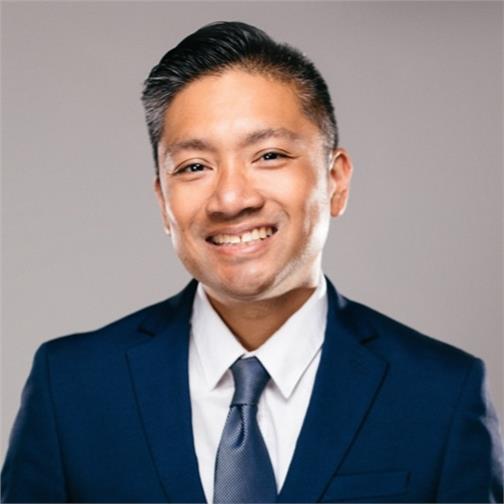
Dr. Rod Daus-Magbual (he/him) comes from an immigrant family who came from Canada via the Philippines to the United States in the early 1980s. Through his family's experiences, he understands what resiliency means and how to apply it in his own life. Heavily influenced by Ethnic Studies, he realized how history shapes identity and how understanding the stories of the oppressed has informed his motivation to serve the community.
Dr. Magbual received his Education Doctorate at the University of San Francisco. He also has played an integral role in mentoring hundreds of students to become teachers and leaders through their participation in the Pin@y Educational Partnerships (PEP). He teaches because he is passionate about social justice and believes in his students.
Dr. Rod learned from his students and their families that they share similar experiences. They expressed narratives of holding down multiple jobs, going to school, and supporting their family. For many, the struggle has become unbearable. He listened to stories of students which led him to successfully run as a Daly City Council member and ultimately to the role of Mayor Rod in addition to Dr. Rod and Professor Rod.
A. Villela-Smith
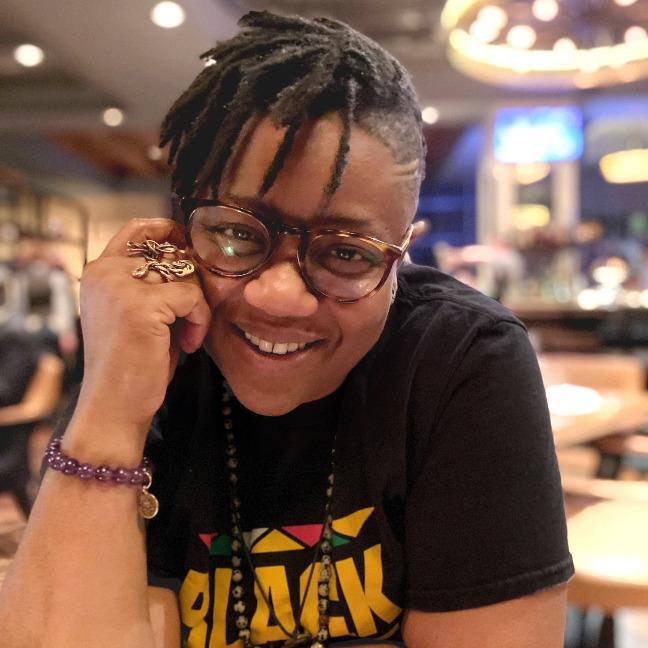
A. Villela-Smith (she/her) is a non-binary Black queer multimedia performer, producer, educator, activist, and DJ. In 2015, she graduated with her master's degree in Ethnic Studies at SF State. Since, she has been teaching comparative ethnic and Black Studies for the past six years.
A's previous research centered on Black queer media. She looked at how film and television constructed Black female masculinity and how that representation informs the lived-experiences of Black masculine of center cisgendered women.
A has also engaged in constructing Black queer representation. Her TV series Dyke Central (2012), centered the experience of a Black masculine of center lesbian living in and navigating through Oakland queer scene.
As a performance artist, A engages in theatrical storytelling through multimedia and drag performance.
Ronny Batista
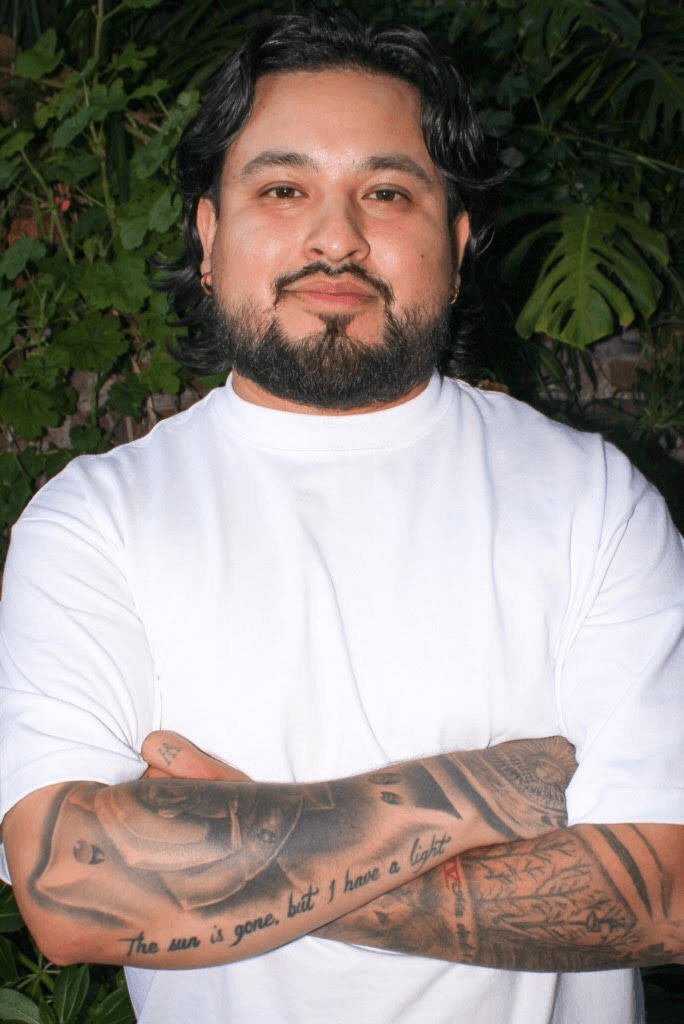
My name is Ronny Batista (He/Him/Él), and I was born and raised in San Francisco’s Mission District. Coming from a Central American family with Salvadoran and Guatemalan roots, my upbringing in the Mission has shaped how I understand community, culture, identity, and the importance of knowing where we come from.
I attended San Francisco State University, where I was deeply influenced by the College of Ethnic Studies and its history. I earned my B.A. in Latina/o Studies and later returned to earn my M.A. in Ethnic Studies. My research focuses on barbershops as spaces of community and healing, particularly how barbers can serve as informal therapists and create spaces for men to connect and support one another.
My teaching is centered around En lo k’ech, a Mayan concept meaning, “You are my other me.” I want my students to know that we are in this learning journey together: I see you, and you see me. My goal is to create a classroom where students feel that their experiences, communities, cultures, and stories are an important part of what we learn together.
The Ethnic Studies Program Learning Outcomes (PLOs) are currently under construction.
Location: Building 1
Email: socialsci-creativearts@smccd.edu
Primary Contact
Faculty
